
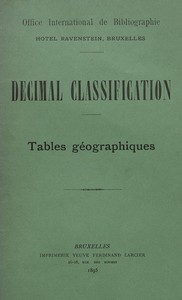
Decimal Classification. Tables géographiques
Let's clear this up right away: this is not a novel. You won't find characters or a plot twist. 'Decimal Classification. Tables géographiques' is a technical manual published in 1899 by the International Institute of Bibliography (which later became the International Federation for Information and Documentation). It's a single piece of a much larger project: the Universal Decimal Classification (UDC) system.
The Story
The 'story' here is one of human ambition. In the late 1800s, information was exploding. Scholars were drowning in journals and books with no good way to find what they needed. Two Belgian lawyers, Paul Otlet and Henri La Fontaine, had a wild idea: create a single, universal classification system for everything ever published. This little book is a slice of that massive effort. It focuses entirely on the 'geographical tables'—the part of the system that codes every country, region, and city with a unique decimal number. The 'plot' is the meticulous, almost obsessive, work of trying to fit the entire physical world into a logical, numbered framework. It's a snapshot of a moment when people believed you could organize all of human knowledge into one perfect, searchable index.
Why You Should Read It
I picked this up out of sheer curiosity and found it weirdly fascinating. It's like archeology for the internet age. Flipping through the tables, you see a world view frozen in 1899. The codes reveal what places were considered important then, how borders were drawn, and how the world was understood. It's the skeleton of every library database and search engine that came after. Reading it makes you appreciate the invisible structures that let us find information today. It’s a humble book with a colossal legacy. It reminds you that behind every simple search bar, there's a century of people trying to solve the same basic problem: how do we connect a question with an answer?
Final Verdict
This is a niche read, but a rewarding one. It's perfect for history buffs, library science students, or anyone obsessed with how information works. If you love the origins of everyday things, or get a kick out of old reference books, you'll find something compelling here. It's not for someone looking for a relaxing bedtime story. But if you've ever wondered how we started organizing knowledge before computers, this is a foundational text. Think of it as a quiet, important artifact from the dawn of the information age.




Ethan Davis
10 months agoThe fonts used are very comfortable for long reading sessions.