
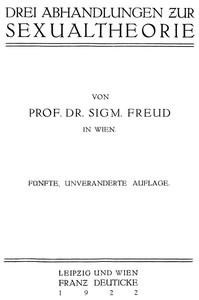
Drei Abhandlungen zur Sexualtheorie by Sigmund Freud
Let's be clear from the start: this is not a novel. There's no protagonist to follow, no cliffhanger at the end of a chapter. Drei Abhandlungen zur Sexualtheorie (Three Essays on the Theory of Sexuality) is a foundational text that launched a thousand therapy sessions. Freud lays out his radical ideas about human development in three parts.
The Story
The 'story' here is the story of how a human psyche is built. In the first essay, Freud talks about sexual 'aberrations,' arguing that what society calls perversions are actually part of a broad spectrum of human sexuality. The second essay is the big one: infantile sexuality. Freud claims that from birth, we have sexual energy (libido) that develops in stages—oral, anal, phallic. Our experiences (and frustrations) in these early years fundamentally shape our adult personalities. The third essay looks at the transformation of puberty, where these childhood currents are channeled into adult sexuality. The central drama is the internal conflict between our primal drives and the demands of civilized society.
Why You Should Read It
You should read this not as absolute truth, but as a fascinating, flawed, and incredibly influential piece of intellectual history. It's gripping because Freud is connecting dots no one had seriously connected before. When he writes about childhood, it feels startlingly personal. His concepts—like the Oedipus complex or repression—have seeped so deeply into our culture that we use them without knowing where they came from. Reading the source material is a revelation. You'll find yourself nodding at some insights, laughing at his now-outdated biology, and gasping at his audacity. It makes you an active participant, constantly questioning: 'Do I buy this?'
Final Verdict
This book is perfect for curious readers who enjoy big ideas that challenge the status quo. It's for anyone interested in psychology, philosophy, or the history of ideas. If you've ever wondered why terms like 'Freudian slip' or 'anal-retentive' exist, here's your answer. Be warned: it's a dense, translated academic text from 1905, so some passages are a slog. But push through. You're not reading it for plot twists; you're reading it to witness a seismic shift in how we understand ourselves. Approach it with a critical mind, and you'll come away with a much richer understanding of the modern world's psychological vocabulary.






Susan Robinson
1 year agoFrom the very first page, it challenges the reader's perspective in an intellectual way. Exceeded all my expectations.