About 528 minutes
The Letters of William James, Vol. 2 — Text and Context
Historical Psychological Social Fiction
121,417 recorded words. 88 minutes difference from this book's estimate.
View Gutenberg source #38091
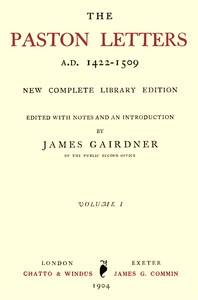
The catalog record for The Paston Letters, A.D. 1422-1509. Volume 1 (of 6) New Complete Library Edition — Themes and Context provides practical reading context through 141,600 words, 10 hr 16 min estimated reading time, and 19 detected text sections.
The text analysis averages about 24.5 words per sentence, while the detected sections provide another way to judge how the source is divided.
Project Gutenberg metadata also associates the work with “England -- Social life and customs -- 1066-1485 -- Sources,” connecting these edition facts with the source record’s subject description.
Explore this collection
These alternatives are selected using recorded categories and estimated reading time.
About 528 minutes
Historical Psychological Social Fiction
121,417 recorded words. 88 minutes difference from this book's estimate.
View Gutenberg source #38091About 524 minutes
Historical Psychological Social Fiction
120,329 recorded words. 92 minutes difference from this book's estimate.
View Gutenberg source #205About 497 minutes
Historical Psychological Social Fiction
114,269 recorded words. 119 minutes difference from this book's estimate.
View Gutenberg source #8642Search stored excerpts and compare books → Choose by your preferences →
Choices use stored catalog measurements. Estimates vary with reading speed. A shared category is a catalog label, not a claim that two books have the same argument or literary quality.
Search reads excerpt text stored with this catalog and links to its associated Gutenberg record. The connection is stored in the site database; this tool does not recheck that every excerpt is word-for-word identical to that external record. Excerpt search does not cover every chapter and does not verify historical publication dates.
Catalog snapshot checked: 2026-09-25. Coverage: 94 public books, 94 available source excerpts.
Read the complete public-domain text at its original source.
Read on Project GutenbergThe volume begins not with a letter but with a substantial preface and introduction by editor James Gairdner, who first published the Paston Letters in 1787. Gairdner immediately establishes the letters as a window into 15th-century England, noting that they "drew public attention" upon their initial release. The editorial framework is dense: footnotes keyed to page numbers, cross-references to other volumes, and meticulous textual notes about typographical errors (such as italic "d" misprinted as "a") and the use of "z" to represent the original yogh (ȝ). This apparatus signals that the reader is entering a scholarly reconstruction, not a raw transcription.
Gairdner's preface and introduction occupy the first several pages, setting the stage for the letters that follow. He provides a narrative of the Wars of the Roses, referencing specific events like the Great Council of November 1457 and the reconciliation attempts of 1458. The editor cites primary sources—Rymer's Foedera, the Rolls of Parliament, and chronicles by Fabyan and Monstrelet—to contextualize the letters. For instance, he notes that the Earl of Warwick was "detained by contrary winds" when traveling from Calais to London. This framing is not neutral; Gairdner interprets the political maneuvers, as when he remarks that the persecution of Bishop Pecock "augured little good for that union of parties." Readers should be aware that the editor's voice shapes the historical lens through which the letters are presented.
The volume's footnotes and endnotes serve multiple functions. Some identify individuals mentioned in the letters, such as "Pecock, Bishop of Chichester." Others clarify obscure references—for example, noting that Tutbury was part of Queen Margaret's dower. Many notes provide cross-references to other letters in the collection (e.g., "No. 330, 331") or to external sources like the Patent Roll. The editor also flags textual cruces: missing letters are marked as "invisible," and damaged text is represented by series of dots. These annotations are essential for understanding the letters' allusions, but they also remind the reader that the text is a reconstructed artifact, not a seamless narrative.
The excerpts from the introduction show how Gairdner uses the letters to reconstruct political events. He cites specific letters (e.g., No. 345, 348) to trace the movements of King Henry VI and Queen Margaret in 1456-1458. The editor also notes discrepancies between the letters and other sources, such as Fabyan's chronicle, regarding the Earl of Salisbury's arrival in London. This comparative method reveals the letters' value as primary evidence, but also their limitations: they offer a partial, often partisan perspective. Readers should approach each letter as a piece of a larger puzzle, with Gairdner's commentary providing one possible interpretation.
This first volume of six contains letters from 1422 to 1509, arranged chronologically. The editor has included a table of contents and an index (in Volume VI) to aid navigation. Footnotes are grouped at the end of each section, and typographical errors are listed after each letter. The e-text also includes a feature allowing direct access to any page by appending #pageN to the URL. Readers unfamiliar with 15th-century English should note that the text preserves original spellings and abbreviations, with editorial corrections clearly marked. The volume's scholarly apparatus is designed for reference, not continuous reading; dipping into individual letters and their annotations is a practical approach.
To read this volume effectively, start with the preface and introduction to understand Gairdner's editorial stance. Then sample a few letters from different decades, using the footnotes to clarify references. The index in Volume VI can help locate specific people or events. Remember that the letters are not a continuous story but a mosaic of voices; the editor's commentary is a guide, not a definitive interpretation. Let the letters themselves speak, but listen with an awareness of the historical and editorial context that shapes them.
It’s strange how footnotes can feel like whispers from the past. I kept thinking about those careful editorial notes in the Paston Letters, how they hold space for distant voices. It reminded me of the quiet patience in Three Addresses to Girls at School — Background and Themes — that same gentle trust in being heard, even centuries later. Some books just sit with you.
Build a private reading journal entry for this title.









