About 91 minutes
The Tricks of the Town: or, Ways and Means of getting Money — Context and Discussion
Historical Psychological Social Fiction
20,837 recorded words. 10 minutes difference from this book's estimate.
View Gutenberg source #29582
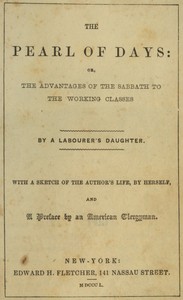
The source record for The pearl of days — A Closer Reading measures this digital text at 23,042 words, 1 hr 41 min estimated reading time, and 15 detected text sections.
The text analysis averages about 37.4 words per sentence, while the detected sections provide another way to judge how the source is divided.
Project Gutenberg metadata also associates the work with “Christian life,” connecting these edition facts with the source record’s subject description.
Explore this collection
These alternatives are selected using recorded categories and estimated reading time.
About 91 minutes
Historical Psychological Social Fiction
20,837 recorded words. 10 minutes difference from this book's estimate.
View Gutenberg source #29582About 65 minutes
Historical Psychological Social Fiction
14,751 recorded words. 36 minutes difference from this book's estimate.
View Gutenberg source #29343About 65 minutes
Historical Psychological Social Fiction
14,945 recorded words. 36 minutes difference from this book's estimate.
View Gutenberg source #40799Search stored excerpts and compare books → Choose by your preferences →
Choices use stored catalog measurements. Estimates vary with reading speed. A shared category is a catalog label, not a claim that two books have the same argument or literary quality.
Search reads excerpt text stored with this catalog and links to its associated Gutenberg record. The connection is stored in the site database; this tool does not recheck that every excerpt is word-for-word identical to that external record. Excerpt search does not cover every chapter and does not verify historical publication dates.
Catalog snapshot checked: 2026-09-25. Coverage: 94 public books, 94 available source excerpts.
Read the complete public-domain text at its original source.
Read on Project GutenbergBarbara H. Farquhar, writing as 'A Labourer’s Daughter,' dedicates her 1850 tract to Queen Victoria, framing the Sabbath as a source of 'temporal advantages' for working people. The book opens with a preface by an American clergyman who praises the author's 'singular discipline and acuteness' and presents the work as evidence that Sabbath-keeping cultivates mind and character even in 'a labouring man’s cottage.' Farquhar’s argument is practical: she contends that observing the Lord’s day as a religious institution, not merely a day of rest, directly improves a worker’s physical health, family life, and economic standing.
The dedication to Queen Victoria is no mere formality. Farquhar writes that 'pages written by a labourer’s daughter should find a Patron in the Queen,' and she links Sabbath observance to loyalty: 'every labourer who learns to keep it holy is another peaceful citizen gained to the community, and another added to those best subjects who, in their weekly assemblies, pray, God Save the Queen.' This rhetorical move positions the tract as both a religious and a political document, arguing that piety reinforces social order. The author also notes that 'nearly a thousand working men' had recently written on the same topic, placing her work within a broader contemporary debate about the Sabbath and the working class.
Farquhar makes a pointed economic case: the Sabbath, by preventing the seventh day from entering the labour market, helps workers 'procure a remuneration for six days’ labour equal to that which, were there no such day, he would be able to obtain for seven.' She contrasts the 'comfort and independence' of those who keep the Sabbath properly with those who treat it merely as recreation, claiming that the latter 'generally fail' even at physical rest and often end up 'begging or borrowing' from their observant neighbours. The argument is grounded in observation: 'Few will have mingled much among labouring men and their families, without meeting with many instances of this kind.'
The author draws a sharp contrast between the wealthy, who may 'slight the obligations of the Sabbath' without visible harm, and the working man, on whom 'the abuse of Sabbath hours is soon visible in a beggared and degraded mind, a depraved moral character, and a consequently degraded condition in society.' She lists specific outcomes: 'squalid, untrained children, and a comfortless home; and not unfrequently, in absolute want of the very necessaries of life.' This passage reveals the tract’s didactic structure: it pairs religious duty with tangible, observable consequences, aiming to persuade through both spiritual and material reasoning.
Readers should note that the surviving text is incomplete; the excerpts break off mid-sentence. The work’s full argument likely continues with further examples and exhortations. Farquhar’s voice is distinctive—earnest, analytical, and grounded in lived experience. Her tract rewards attention as a document of mid-19th-century working-class religious advocacy, where piety and practical economics are inseparable.
Sitting with The Pearl of Days, I kept thinking about the quiet weight of daily intention—how a labourer's daughter once framed rest as a practical gift. It drifted me toward The Letters of William James, Vol. 2 — Text and Context, where his own searching notes on effort and habit feel like a softer echo of that same thoughtful striving. Just a familiar thread, really.
Answer a few questions and save a private reflection on this device.









