About 836 minutes
A Lady of England: The Life and Letters of Charlotte Maria Tucker — Story, Setting & Ideas
Science Fiction Utopias
192,160 recorded words. 135 minutes difference from this book's estimate.
View Gutenberg source #54218
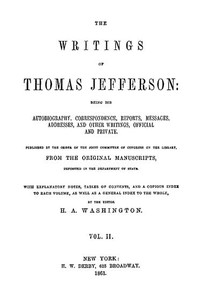
The source record for The Writings of Thomas Jefferson, Vol. 2 (of 9) Being His Autobiography, Correspondence, Reports, Messages, Addresses, and Other Writings, Official and Private — Themes and Context measures this digital text at 223,167 words, 16 hr 11 min estimated reading time, and 27 detected text sections.
The text analysis averages about 21.4 words per sentence, while the detected sections provide another way to judge how the source is divided.
Project Gutenberg metadata also associates the work with “United States -- Politics and government -- 1775-1783,” connecting these edition facts with the source record’s subject description.
Explore this collection
These alternatives are selected using recorded categories and estimated reading time.
About 836 minutes
Science Fiction Utopias
192,160 recorded words. 135 minutes difference from this book's estimate.
View Gutenberg source #54218About 820 minutes
Science Fiction Utopias
188,530 recorded words. 151 minutes difference from this book's estimate.
View Gutenberg source #30192About 761 minutes
Science Fiction Utopias
174,941 recorded words. 210 minutes difference from this book's estimate.
View Gutenberg source #12025Search stored excerpts and compare books → Choose by your preferences →
Choices use stored catalog measurements. Estimates vary with reading speed. A shared category is a catalog label, not a claim that two books have the same argument or literary quality.
Search reads excerpt text stored with this catalog and links to its associated Gutenberg record. The connection is stored in the site database; this tool does not recheck that every excerpt is word-for-word identical to that external record. Excerpt search does not cover every chapter and does not verify historical publication dates.
Catalog snapshot checked: 2026-09-25. Coverage: 94 public books, 94 available source excerpts.
Read the complete public-domain text at its original source.
Read on Project GutenbergJefferson's diplomatic correspondence in this volume displays a voice that shifts between formal reportage and pointed private reflection. In a letter to John Jay, he coolly calculates the cost of ransoming American captives in Algiers, arguing that paying the lowest price is 'cruelty to the individuals now in captivity, but kindness to the hundreds that would soon be so.' The same letter includes a frustrated search for 'Monsieur Pauly, avocat au conseil d'etat'—a missing person whose address proves incorrect, prompting Jefferson to advertise in public papers. This blend of high policy and mundane logistics recurs throughout the volume.
Jefferson's letters alternate between the measured cadence of diplomatic protocol and a more direct, sometimes impatient tone. When reporting the Dutch ambassador's message about Dumas, he embeds the ambassador's formal phrasing—'that the States General had received a written application from Mr. Adams'—within his own concise summary. Yet in the same paragraph, he shifts to a practical problem: the missing avocat. The sentence 'There is no such person living in that street' lands with flat finality, a contrast to the elaborate courtesies that open and close his letters. This juxtaposition reveals a writer who respects form but values efficiency.
Jefferson's approach to the Algerian captives is striking for its unsentimental arithmetic. He notes that 'Russian captives have cost about eight thousand livres apiece' and immediately rejects that sum for Americans. His reasoning is strategic: paying less makes Americans less attractive targets. The phrase 'this is cruelty to the individuals now in captivity, but kindness to the hundreds that would soon be so' frames a moral trade-off in stark, almost clinical terms. The passage shows Jefferson weighing immediate human cost against long-term deterrence, a pattern that recurs in his discussions of naval armaments and trade negotiations.
Beyond policy, the volume is filled with small, concrete details that ground abstract negotiations. Jefferson mentions enclosing 'a letter from O'Bryan to me, containing information from Algiers, and one from Mr. Montgomery, at Alicant.' He tracks the progress of medals, the fate of a vessel called Boss, and the need for 'constant attention' to ransom negotiations. These specifics create a texture of daily work—letters forwarded, addresses corrected, sums calculated. The editor H. A. Washington's extensive index and table of contents further emphasize the documentary nature of the collection, inviting readers to trace threads across hundreds of pages.
Readers approaching this volume will benefit from attending to the interplay between Jefferson's public and private registers. The letters reward slow reading: a single paragraph often moves from a diplomatic nicety to a blunt assessment to a logistical note. The editor's apparatus—particularly the index—helps locate recurring correspondents and topics. This is not a narrative but a mosaic, and its coherence emerges from Jefferson's consistent habits of mind: precise, pragmatic, and alert to the gap between intention and outcome.
There’s something grounding about watching a careful mind work through the world’s mess—Jefferson tallying ransoms or tracing a missing lawyer feels almost like sitting beside a friend assembling a scattered puzzle. That same quiet patience hums through A Century of Science, and Other Essays — Background and Themes, where thought lingers gently rather than rushing. It stayed with me like a half-remembered conversation, soft and unhurried.
Build a private reading journal entry for this title.









