About 482 minutes
Specimens of the Table Talk of Samuel Taylor Coleridge — Reading Companion
Science Fiction Utopias
110,822 recorded words. 4 minutes difference from this book's estimate.
View Gutenberg source #8489
William Blake: A Critical Essay — Text and Context can be approached with a clearer sense of reading commitment from its source measurements: 109,716 words, 7 hr 58 min estimated reading time, and 11 detected text sections.
The text analysis averages about 28.4 words per sentence, while the detected sections provide another way to judge how the source is divided.
Project Gutenberg metadata also associates the work with “Poets, English -- 19th century -- Biography,” connecting these edition facts with the source record’s subject description.
Explore this collection
These alternatives are selected using recorded categories and estimated reading time.
About 482 minutes
Science Fiction Utopias
110,822 recorded words. 4 minutes difference from this book's estimate.
View Gutenberg source #8489About 466 minutes
Science Fiction Utopias
107,152 recorded words. 12 minutes difference from this book's estimate.
View Gutenberg source #40590About 496 minutes
Science Fiction Utopias
114,075 recorded words. 18 minutes difference from this book's estimate.
View Gutenberg source #40307Search stored excerpts and compare books → Choose by your preferences →
Choices use stored catalog measurements. Estimates vary with reading speed. A shared category is a catalog label, not a claim that two books have the same argument or literary quality.
Search reads excerpt text stored with this catalog and links to its associated Gutenberg record. The connection is stored in the site database; this tool does not recheck that every excerpt is word-for-word identical to that external record. Excerpt search does not cover every chapter and does not verify historical publication dates.
Catalog snapshot checked: 2026-09-25. Coverage: 94 public books, 94 available source excerpts.
Read the complete public-domain text at its original source.
Read on Project GutenbergSwinburne opens his essay by addressing the dedication to William Michael Rossetti, acknowledging that the work grew "idly and gradually" from a review into an elaborate study. He positions it as a complement, not a competitor, to existing biography, aiming to fill gaps he saw in Blake scholarship. The dedication sets a tone of frank admiration and intellectual kinship, with Swinburne declaring he will "speak not less frankly and clearly than did Blake."
The dedication to Rossetti is more than a courtesy; it outlines Swinburne's method. He admits the book "is not designed to supplant or to compete with the excellent biography of Blake already existing" but to serve as "complement or supplement." This frames the essay as a critical intervention, not a comprehensive life. Swinburne's language—"I found so much unsaid, so much unseen"—reveals his conviction that Blake's work demanded a new kind of attention. The dedication also hints at the essay's origin in a review, suggesting a gradual deepening of engagement.
In the excerpt discussing the "Proverbs of Hell," Swinburne quotes several of Blake's most provocative sayings, such as "Prisons are built with stones of Law; brothels with bricks of Religion" and "Sooner murder an infant in its cradle than nurse unacted desires." He interprets these as expressions of Blake's "evangel of bodily liberty" and his belief in the identity of body with soul. Swinburne does not shy from the radical implications, noting that "translated into rough practice, and planted in a less pure soil than that of the writer's mind, this philosophy might bring forth a strange harvest." He insists on distinguishing explanation from apology, a key critical stance.
The table of contents reveals a tripartite structure: "Life and Designs," "Lyrical Poems," and "The Prophetic Books." This organization allows Swinburne to move from biography to close reading of Blake's shorter works, then to the more challenging prophetic books. The progression suggests a pedagogical intent: to guide readers from accessible material to the difficult, visionary texts. Swinburne's own prose, as seen in the excerpts, is dense and allusive, matching the complexity of his subject. He frequently uses Blake's own phrases to anchor his analysis, as when he cites "Rintrah" as the spirit of fire and storm.
Throughout the excerpt, Swinburne's voice is distinctive: he praises Blake's "high clear spirit and stainless intellect" while acknowledging the heresies of his doctrine. He writes that "Apology shall now and always remain as far from us as it was in life from Blake himself." This refusal to apologize for Blake's radicalism is a defining feature of the essay. Swinburne also employs vivid metaphors—"the salt bread of scorn and the bitter wine of wrath"—that echo Blake's own prophetic style. The critical approach is one of sympathetic but rigorous engagement, treating Blake as a serious thinker whose ideas demand careful unpacking.
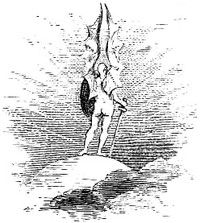
The original 1868 edition included facsimile illustrations from Blake's designs, both coloured and plain. Swinburne's text references these images, as when he notes "Larger Image" markers in the excerpts. The interplay between verbal and visual analysis is integral to his method. He treats Blake's designs as co-equal with his poetry, a holistic approach that was innovative for its time. Readers of the digital edition should be aware that the illustrations are not reproduced here, but Swinburne's descriptions often compensate, guiding the eye as well as the mind.
Swinburne's essay remains a landmark in Blake criticism for its unapologetic defence of Blake's most challenging ideas. Readers new to Blake may find it useful to start with the lyrical poems section, where Swinburne's close reading is most accessible, before tackling the prophetic books. The essay rewards those who read it alongside Blake's own texts, as Swinburne constantly references specific lines and images. His prose, though dense, is never dry; it pulses with the same energy he admired in Blake.
There are afternoons when Swinburne’s Blake feels less like criticism and more like a conversation held too late, by lamplight. His patience with Blake’s stubborn visions made me think of another voice, equally unhurried, asking what faith and doubt truly owe each other. That quieter book, Essays on God and Freud — Reading Notes, sits beside it now, a strange but gentle companion.
Capture what you thought, learned, and would like to remember.









