About 52 minutes
Diary of Samuel Pepys — Volume 70: December 1668 — Story, Setting & Ideas
Historical Psychological Social Fiction
11,755 recorded words. 3 minutes difference from this book's estimate.
View Gutenberg source #4194
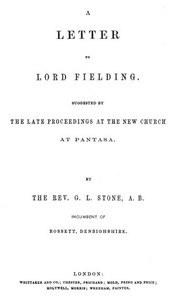
The source record for A Letter to Lord Fielding. Suggested by the late proceedings at the New Church at Pantasa — Edition Insights measures this digital text at 11,163 words, 49 min estimated reading time, and 2 detected text sections.
The text analysis averages about 20.3 words per sentence, while the detected sections provide another way to judge how the source is divided.
Project Gutenberg metadata also associates the work with “Catholic Church,” connecting these edition facts with the source record’s subject description.
Explore this collection
These alternatives are selected using recorded categories and estimated reading time.
About 52 minutes
Historical Psychological Social Fiction
11,755 recorded words. 3 minutes difference from this book's estimate.
View Gutenberg source #4194About 35 minutes
Historical Psychological Social Fiction
7,999 recorded words. 14 minutes difference from this book's estimate.
View Gutenberg source #3172About 65 minutes
Historical Psychological Social Fiction
14,751 recorded words. 16 minutes difference from this book's estimate.
View Gutenberg source #29343Search stored excerpts and compare books → Choose by your preferences →
Choices use stored catalog measurements. Estimates vary with reading speed. A shared category is a catalog label, not a claim that two books have the same argument or literary quality.
Search reads excerpt text stored with this catalog and links to its associated Gutenberg record. The connection is stored in the site database; this tool does not recheck that every excerpt is word-for-word identical to that external record. Excerpt search does not cover every chapter and does not verify historical publication dates.
Catalog snapshot checked: 2026-09-25. Coverage: 94 public books, 94 available source excerpts.
Read the complete public-domain text at its original source.
Read on Project GutenbergGeorge Luther Stone, incumbent of Rossett in Denbighshire, addresses his 1852 letter directly to Lord Fielding, a nobleman who had recently converted to Roman Catholicism and alienated the church at Pantasaph from the Church of England. Stone frames his argument around a passage from the Irish Catholic Bishop Doyle, who in 1824 asserted that no essential difference existed between the Roman and English churches on most disputed points. Stone seizes this as a logical trap: if Doyle was right, Fielding had no cause to leave; if wrong, a material difference must be proved. The letter thus becomes a point-by-point doctrinal refutation, grounded in Scripture and early church authority, and aimed at reclaiming a wayward peer.
Stone opens by quoting Bishop Doyle’s claim that the chief points of difference—canon, faith, sacraments, tradition, papal authority, and others—admit of satisfactory explanation and that division arises from pride and prejudice rather than substance. Stone immediately challenges Fielding: if Doyle wrote truth, why abandon the English Church for a foreign system with no material difference? If falsehood, Stone leaves Fielding to settle with Doyle. This rhetorical gambit sets the letter’s tone: logical, confrontational, and anchored in a specific published statement. Stone then declares that a material difference does exist, as great as between light and darkness, and promises to prove it from Scripture against what he calls the unfounded figments of Tridentine manufacture. The reference to St. Cyprian’s dove and raven foreshadows his hope that Fielding will return to the ark of the English Church.
Stone systematically examines the seven sacraments claimed by Rome, starting with confirmation and penance. He notes that confirmation, though a sacred rite of apostolic origin, was not instituted by Christ and therefore cannot be a sacrament. Penance, he argues, is a godly discipline but not Christ-instituted. He then turns to confession, addressing Fielding directly with a warning about the filthy questions to which married ladies are subject in the confessional. Stone refuses to print an abstract of the questions, calling them loathsome and disgustingly offensive, but urges Fielding to read the instructions in Dens and Baillie, the Maynooth class books, before allowing any female friend to confess. He accuses the Roman Church of enchanting Fielding’s soul, contrasting it with the freedom of a slave chained to the plough. On extreme unction, Stone cites the Council of Trent’s language—insinuavit and tanquam—as evidence that Christ only insinuated it, and notes that Cardinal Cajetan denied the Tridentine insinuation. He also points out that Bishop Doyle’s catechism admits the time of institution is uncertain, which he finds absurd for an infallible church.
Stone continues with holy orders and matrimony. He acknowledges that Scripture and ancient authors show bishops, priests, and deacons from apostolic times, but insists Christ himself did not institute holy orders, so it cannot be a sacrament. Matrimony, he notes, was instituted in man’s innocency, yet Rome’s definition of a sacrament forces a contradiction: if matrimony is a sacrament, it must have been instituted by Christ, which would place its origin after the Fall. Stone finds it marvellous that a church which exalts matrimony as a sacrament deems it too polluting for its clergy. He then turns to faith and justification, preferring to cite the Bible directly: “He that believeth and is baptised shall be saved.” The letter’s structure—moving from Doyle’s premise through each sacrament to scriptural proof—reveals Stone’s method: logical deduction from authoritative sources, designed to corner Fielding into either rejecting Rome’s definitions or admitting inconsistency.
Stone’s letter is a specimen of mid-nineteenth-century Anglican polemic, blending theological argument with personal admonition. Readers should note that the text is incomplete in this edition; the excerpts break off during the discussion of faith and justification. The work assumes familiarity with the Council of Trent, Bishop Doyle’s writings, and the Maynooth class books. Stone’s tone shifts from reasoned debate to visceral warning, particularly on confession, reflecting the era’s anti-Catholic sentiment. The letter is best read as a period artifact of religious controversy rather than a dispassionate survey.
Reading that Welsh clergyman’s careful, worried letter made me think how arguments ossify over time, yet the ache stays tender. I found a similar lingering in The Paston Letters, A.D. 1422-1509. Volume 1 (of 6) New Complete Library Edition — Themes and Context—ordinary people, centuries apart, pleading their faith and property in ink. That small, human tremor binds them, quiet and unbroken.
Answer a few questions and save a private reflection on this device.









