About 215 minutes
Adventures in Contentment — Reading Companion
Historical Psychological Social Fiction
49,336 recorded words. 15 minutes difference from this book's estimate.
View Gutenberg source #10605
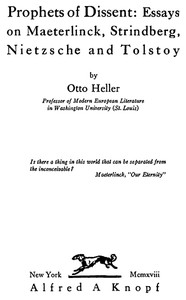
The catalog record for Prophets of Dissent : Essays on Maeterlinck, Strindberg, Nietzsche and Tolstoy — Key Ideas to Explore provides practical reading context through 45,873 words, 3 hr 20 min estimated reading time, and 5 detected text sections.
The text analysis averages about 26.4 words per sentence, while the detected sections provide another way to judge how the source is divided.
Project Gutenberg metadata also associates the work with “Tolstoy, Leo, graf, 1828-1910,” connecting these edition facts with the source record’s subject description.
Explore this collection
These alternatives are selected using recorded categories and estimated reading time.
About 215 minutes
Historical Psychological Social Fiction
49,336 recorded words. 15 minutes difference from this book's estimate.
View Gutenberg source #10605About 244 minutes
Historical Psychological Social Fiction
55,952 recorded words. 44 minutes difference from this book's estimate.
View Gutenberg source #49545About 143 minutes
Historical Psychological Social Fiction
32,700 recorded words. 57 minutes difference from this book's estimate.
View Gutenberg source #42494Search stored excerpts and compare books → Choose by your preferences →
Choices use stored catalog measurements. Estimates vary with reading speed. A shared category is a catalog label, not a claim that two books have the same argument or literary quality.
Search reads excerpt text stored with this catalog and links to its associated Gutenberg record. The connection is stored in the site database; this tool does not recheck that every excerpt is word-for-word identical to that external record. Excerpt search does not cover every chapter and does not verify historical publication dates.
Catalog snapshot checked: 2026-09-25. Coverage: 94 public books, 94 available source excerpts.
Read the complete public-domain text at its original source.
Read on Project GutenbergOtto Heller opens his 1918 collection by defending the grouping of four seemingly disparate authors—Maeterlinck, Strindberg, Nietzsche, and Tolstoy—as 'foremost literary expositors of important modern tendencies.' Rather than offering a conventional survey, Heller foregrounds the voice of each writer, treating their stylistic choices as integral to their dissent. The preface itself sets a measured, analytical tone, but the essays shift dramatically in pace: Nietzsche's section, for instance, adopts a more urgent, almost breathless rhythm to match its subject's 'tremendous spiritual heat,' while Maeterlinck's is more contemplative. Heller is attentive to how each prophet's language—whether lyrical, dramatic, or coldly logical—shapes their message.
Heller portrays Nietzsche as a writer whose 'vaticinations' are 'enunciated with tremendous spiritual heat and lofty gesture,' a style that acts as 'a moral intoxicant.' The essay's own prose accelerates when discussing Nietzsche, mirroring the subject's intensity. Heller notes that Nietzsche's doctrine, though 'flagrantly irrational,' contains 'a perfectly coherent doctrine'—but one that must be grasped by 'flashlike seizure' rather than logical analysis. This emphasis on intuitive apprehension over systematic reasoning is reflected in Heller's own shift from measured exposition to more impassioned, aphoristic phrasing. He contrasts Nietzsche with Machiavelli and Stirner, calling them 'logicians rather than moralists,' while Nietzsche is a 'vision of a genius.' The pace of the essay thus enacts the very distinction it draws: cold reasoning versus visionary heat.
In contrast to Nietzsche's fiery tempo, Heller's treatment of Maeterlinck adopts a slower, more meditative rhythm. The epigraph from Maeterlinck—'Is there a thing in this world that can be separated from the inconceivable?'—sets a philosophical, questioning tone. Heller likely dwells on Maeterlinck's use of silence and suggestion, though the excerpts do not fully reveal the essay's content. The shift in pace between the Nietzsche and Maeterlinck sections is deliberate: Heller uses sentence length and paragraph structure to evoke each author's characteristic voice. Where Nietzsche's section is dense with exclamatory clauses, Maeterlinck's appears more measured, with longer, flowing sentences that invite reflection. This stylistic modulation demonstrates Heller's sensitivity to how narrative voice conveys philosophical stance.
Heller's essays on Tolstoy and Strindberg, though less represented in the excerpts, likely continue this pattern of stylistic mimicry. Tolstoy's moral directness would call for a plain, urgent prose, while Strindberg's psychological turmoil might demand a more fragmented, intense rhythm. The preface hints at Heller's broader method: he treats each writer as an 'indicator of contrarious ideal currents,' adjusting his own voice to highlight their 'personal equation.' The reader should attend to how Heller's syntax and pacing shift from essay to essay—these changes are not arbitrary but are analytical tools. By varying his own narrative pace, Heller makes visible the 'spiritual attitudes' that define each prophet's dissent.
Heller's essays reward attention to their own stylistic architecture. As you read, note how the prose accelerates or slows, becomes more lyrical or more clipped, in response to each subject. These shifts are not decorative; they are Heller's method of making the reader feel the 'moral intoxicant' of Nietzsche, the contemplative pull of Maeterlinck, and the urgent moral weight of Tolstoy. The collection is as much about the how of dissent as the what.
Prophets of Dissent puts me in mind of my grandfather’s shelf, where Tolstoy’s stubborn no, and Maeterlinck’s quiet hush, sat unread side by side. I once felt that same patience crack open while finishing A Letter to Lord Fielding — its careful, sacramental anger slowing my own pulse, a dissent not shouted but heard through walls of reform. A Letter to Lord Fielding. Suggested by the late proceedings at the New Church at Pantasa — Edition Insights swallowed me whole, the way Heller’s listening does here.
Use these questions to collect your thoughts before moving on.









