About 583 minutes
The Complete Writings of Charles Dudley Warner — Volume 3 — A Closer Reading
Adventure Picaresque Fiction
134,010 recorded words. 39 minutes difference from this book's estimate.
View Gutenberg source #2673
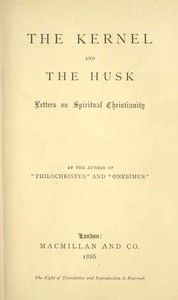
The source record for The Kernel and the Husk: Letters on Spiritual Christianity — Background and Themes measures this digital text at 125,054 words, 9 hr 4 min estimated reading time, and 35 detected text sections.
The text analysis averages about 31.1 words per sentence, while the detected sections provide another way to judge how the source is divided.
Project Gutenberg metadata also associates the work with “Christianity -- Controversial literature,” connecting these edition facts with the source record’s subject description.
Explore this collection
These alternatives are selected using recorded categories and estimated reading time.
About 583 minutes
Adventure Picaresque Fiction
134,010 recorded words. 39 minutes difference from this book's estimate.
View Gutenberg source #2673About 702 minutes
Adventure Picaresque Fiction
161,458 recorded words. 158 minutes difference from this book's estimate.
View Gutenberg source #26572About 368 minutes
Adventure Picaresque Fiction
84,538 recorded words. 176 minutes difference from this book's estimate.
View Gutenberg source #8777Search stored excerpts and compare books → Choose by your preferences →
Choices use stored catalog measurements. Estimates vary with reading speed. A shared category is a catalog label, not a claim that two books have the same argument or literary quality.
Search reads excerpt text stored with this catalog and links to its associated Gutenberg record. The connection is stored in the site database; this tool does not recheck that every excerpt is word-for-word identical to that external record. Excerpt search does not cover every chapter and does not verify historical publication dates.
Catalog snapshot checked: 2026-09-25. Coverage: 94 public books, 94 available source excerpts.
Read the complete public-domain text at its original source.
Read on Project GutenbergThe book opens with a striking dedication 'To the Doubters of this Generation and the Believers of the Next,' immediately signaling its intended audience. In the preface, Abbott recounts a deathbed visit from a fellow clergyman who had fallen into 'reverent agnosticism' after reading Abbott's earlier work Philochristus. This personal encounter frames the entire work: the letters are not abstract theology but a pastoral response to real spiritual crisis.
The author warns that those who 'worship a miraculous Christ without doubt and difficulty' should read no further. Instead, he addresses those who feel drawn to Christ yet are repelled by the miraculous element that seems to cast doubt on His entire story. The letters aim to show that one can find 'peace and salvation in the worship of a non-miraculous Christ.'
The work consists of 35 letters, each functioning as a discrete argument while building cumulatively. The epistolary form allows Abbott to adopt a conversational, exploratory tone, often anticipating objections and addressing them directly. The letters move from general principles to specific Gospel passages, then to broader theological implications. This structure mirrors the author's method: he does not assert conclusions dogmatically but leads the reader through a process of reasoning.
Each letter typically begins with a reference to the recipient's previous query or doubt, creating a sense of dialogue. Abbott frequently uses phrases like 'You ask me' or 'I think I hear you say' to maintain this interactive quality. The letters vary in length and density, with some focusing on a single miracle narrative and others on broader concepts like faith, inspiration, or the nature of Christ. The cumulative effect is a sustained argument that respects the reader's intelligence while acknowledging the emotional stakes involved.
The central metaphor of the title—kernel and husk—appears throughout the letters as a way to distinguish essential spiritual truth from its outward, often miraculous, packaging. Abbott uses this image to argue that the 'husk' of miracle stories can be discarded without losing the 'kernel' of Christ's spiritual significance. The metaphor recurs in discussions of Gospel narratives, where Abbott suggests that the literal, miraculous husk may have been added by early Christian communities.
Another recurring image is that of the 'fish' as an emblem of Christ, drawn from early Christian art. Abbott points to this as evidence that the earliest believers understood Christ symbolically rather than literally. He also frequently invokes the image of 'hymns and spiritual songs' as a creative force that shaped Gospel traditions, arguing that poetic hyperbole in worship could generate miracle stories when later interpreted literally. These images serve as anchors for Abbott's broader argument about the development of Christian tradition.
Abbott's argument moves fluidly between different historical and emotional scenes. The preface places us at a deathbed, where a dying clergyman seeks reassurance. This intimate, urgent setting gives way to scholarly analysis of first-century Christian worship, where Abbott imagines a congregation 'singing a hymn to Christ as to a God' in the reign of Vespasian or Domitian. The shift from personal crisis to historical reconstruction is characteristic of Abbott's method.
He also moves between Gospel accounts, comparing the different versions of the same event to show how miracles were amplified over time. For instance, he notes that the instruction to 'raise the dead' appears only in Matthew, not in Mark, and argues that the disciples never actually performed such acts during Jesus' lifetime. This comparative movement across texts allows Abbott to trace the development of miracle traditions without dismissing the Gospels as unreliable. The reader is constantly shuttled between the first-century context and the nineteenth-century doubter's predicament.
A key argument in the letters is that many Gospel miracles originated from reading the Old Testament as prophecy. Abbott describes how early Christian congregations would hear passages about Moses giving water from the rock or Elijah raising the widow's son, and then sing hymns applying these types to Christ. The result, he suggests, was that 'poetic hyperbole and metaphor' gradually solidified into literal miracle narratives.
He gives specific examples: the feeding of the multitude echoes Moses' manna; the changing of water into wine is interpreted as Jesus replacing the Law with the Gospel; the resurrection of Christ is linked to Jonah's three days in the fish. Abbott does not claim these are deliberate fabrications but rather a natural process of worship and interpretation. This typological reading explains why certain miracles appear in some Gospels but not others, and why they often carry symbolic weight. The argument is careful not to dismiss the spiritual value of these stories, even while questioning their historicity.
Abbott's letters offer a way to read the Gospels that is both critical and reverent. He does not ask the reader to abandon faith but to distinguish between the kernel of spiritual truth and the husk of miraculous narrative. The work is best approached as a sustained conversation, best read in sequence to follow the development of its argument. For those troubled by the miraculous element in Christianity, these letters provide a thoughtful, historically grounded alternative that preserves the worship of Christ without requiring belief in physical miracles.
I remember sitting with my grandfather’s marked-up Bible, wondering at the quiet way he read the miracles—not as proofs, but as questions. That same patience returned when I opened Lectures Delivered in America in 1874 — Edition Insights; both books feel like someone leaning forward, speaking softly, asking me to hold doubt like a candle rather than a stone.
Save your reaction, strongest insight, and memorable passage.









