About 994 minutes
The Orations of Marcus Tullius Cicero, Volume 4 — A Reader’s Guide
Adventure Picaresque Fiction
228,530 recorded words. 4 minutes difference from this book's estimate.
View Gutenberg source #11080
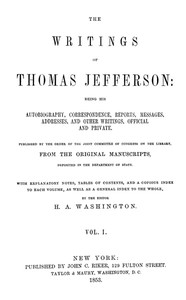
This digital edition of The Writings of Thomas Jefferson, Vol. 1 (of 9) Being His Autobiography, Correspondence, Reports, Messages, Addresses, and Other Writings, Official and Private — Reading Notes is described by source-level measurements including 229,532 words, 16 hr 38 min estimated reading time, and 22 detected text sections.
The text analysis averages about 22.4 words per sentence, while the detected sections provide another way to judge how the source is divided.
Project Gutenberg metadata also associates the work with “United States -- Politics and government -- 1775-1783,” connecting these edition facts with the source record’s subject description.
Explore this collection
These alternatives are selected using recorded categories and estimated reading time.
About 994 minutes
Adventure Picaresque Fiction
228,530 recorded words. 4 minutes difference from this book's estimate.
View Gutenberg source #11080About 950 minutes
Adventure Picaresque Fiction
218,462 recorded words. 48 minutes difference from this book's estimate.
View Gutenberg source #52878About 702 minutes
Adventure Picaresque Fiction
161,458 recorded words. 296 minutes difference from this book's estimate.
View Gutenberg source #26572Search stored excerpts and compare books → Choose by your preferences →
Choices use stored catalog measurements. Estimates vary with reading speed. A shared category is a catalog label, not a claim that two books have the same argument or literary quality.
Search reads excerpt text stored with this catalog and links to its associated Gutenberg record. The connection is stored in the site database; this tool does not recheck that every excerpt is word-for-word identical to that external record. Excerpt search does not cover every chapter and does not verify historical publication dates.
Catalog snapshot checked: 2026-09-25. Coverage: 94 public books, 94 available source excerpts.
Read the complete public-domain text at its original source.
Read on Project GutenbergJefferson's letters in this volume display a consistent rhetorical strategy: he frames even contentious matters as matters of private opinion offered for another's judgment. In a 1784 letter to Colonel Uriah Forrest, he writes that he and his colleagues 'think it is a case in which we could not interpose' without instructions, then adds 'it is, however, our private opinion, which we give as individuals only.' This layered disclaimer—first stating official limits, then offering personal counsel—recurs throughout his correspondence, suggesting a deliberate authorial choice to maintain plausible deniability while still guiding action.
The editor H. A. Washington's preface notes that he selected materials 'which possesses permanent public interest either on account of its intrinsic value, or as matter of history, or as illustrating the character of the distinguished Author.' The resulting collection foregrounds Jefferson's voice in diplomatic, legal, and personal contexts, with minimal editorial interpolation.
Jefferson's letters to John Jay and other officials repeatedly employ a formula of self-deprecation paired with assurance of zeal. In his May 1785 letter accepting the minister plenipotentiary appointment, he writes: 'Fervent zeal is all which I can be sure of carrying into their service, and, where I fail through a want of those powers which nature and circumstances deny me, I shall rely on their indulgence.' The phrasing casts his limitations as inherent ('nature') and situational ('circumstances'), not as failures of effort. This careful positioning—acknowledging potential shortcomings while preemptively requesting leniency—appears in multiple letters, suggesting a practiced diplomatic voice.
Elsewhere, Jefferson uses the passive construction 'I was honored' to announce receipt of official communications, and frequently closes with elaborate assurances of esteem. These formalities are not mere convention; they create a buffer of politeness around substantive political discussions. In the Forrest letter, he concludes by expressing hope that judges' 'knowledge and integrity' will provide 'certain resources against injustice'—a statement that implies confidence in the legal system while leaving room for future congressional intervention if that confidence proves misplaced.
Jefferson's prose in official correspondence is marked by conditional clauses and careful hedging. In the Forrest letter, he writes: 'A final and palpable failure on their part, which we have no reason to apprehend, might make the case proper for the consideration of Congress.' The sentence structure—hypothetical ('might'), qualified ('no reason to apprehend'), and deferred—allows Jefferson to signal a possible course of action without committing to it. This linguistic pattern reflects his legal training and his awareness that written words could be scrutinized by multiple parties.
The editor's transcription notes preserve several textual ambiguities: 'public powder' possibly should read 'public power,' and 'Crochet' may be 'Crocket.' These editorial interventions highlight the challenges of working from manuscript sources. Jefferson's own writing, however, shows consistent grammatical structure even when discussing complex treaty interpretations. His reference to 'the law of nations, and the treaty of peace, as making a part of the law of the land' demonstrates his habit of grounding arguments in legal frameworks, a feature that persists across the volume's official and private writings.
The volume opens with Jefferson's autobiography, but the excerpts provided focus on the correspondence section. The editor's preface explains that the collection aims to be 'a complete depository of the writings of Thomas Jefferson,' selected for 'permanent public interest' and to illustrate 'the character of the distinguished Author.' This editorial lens shapes what readers encounter: letters that reveal Jefferson's diplomatic persona, his legal reasoning, and his personal relationships.
Notably, Jefferson's letter to Forrest includes the phrase 'I consider the whole matter as between ourselves alone, having determined to take no active part in this or anything else, which may lead to altercation.' This statement of withdrawal—written while he was still serving as a diplomat—reveals a tension between public duty and private desire for quiet. The editor's inclusion of such personal reflections alongside official dispatches allows readers to observe Jefferson's self-conscious management of his public and private identities.
Jefferson's letters to John Jay, the American Secretary for Foreign Affairs, show a consistent pattern of acknowledging receipt, expressing gratitude, and then pivoting to substantive matters. In his May 1785 letter, he thanks Jay for notifying him of his appointment as minister plenipotentiary, then immediately offers 'assurance of endeavoring to merit it by a faithful attention to the discharge of the duties annexed to it.' The word 'endeavoring' implies effort without guaranteeing success, a subtle hedge that recurs throughout his official writing.
When discussing the case of Mr. McLanahan, Jefferson and his colleagues 'conferred together' and produced a unified private opinion, but Jefferson is careful to note that this opinion is 'as individuals only.' This distinction between official capacity and personal judgment is a recurring feature of his diplomatic voice. He also uses the phrase 'we are willing to hope' to express cautious optimism about the British legal system, a construction that conveys expectation without certainty. These linguistic choices reveal a writer acutely aware of the weight his words carry in international correspondence.
Readers approaching this volume should attend to the interplay between Jefferson's public statements and his private asides. The editor's selection foregrounds letters where Jefferson explicitly marks the boundary between official and personal opinion, offering a window into his diplomatic method. The volume's arrangement—autobiography followed by correspondence—invites comparison between Jefferson's retrospective self-portrait and the contemporaneous voice captured in his letters. Those interested in the evolution of American diplomatic prose will find rich material in Jefferson's careful calibrations of tone and substance.
I keep returning to this volume’s quieter letters, where Jefferson’s careful wording feels almost like a hand placed over a thought. It reminded me of Emerson’s old lectures on what shapes a person—not the grand gestures, but those deliberate, private choices. There’s a gentle kinship there, across the years. Representative Men: Seven Lectures — Edition Insights still sits beside my chair.
Answer a few questions and save a private reflection on this device.









