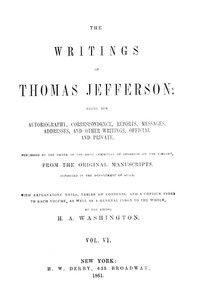
Jefferson's common-place book entry on the case of Quare imp. in C. B. 34, H. 6, fo. 38, exemplifies his method of dissecting legal precedents. He scrutinizes Prisot C. J.'s phrase "ancien scripture," arguing that later jurists like Finch misrepresented it as "Holy Scripture" to claim Christianity was part of common law. Jefferson's marginal annotations and cross-references to Fitzherbert, Brooke, and Wingate show a mind trained in Coke Littleton, yet bold enough to challenge established authorities. This volume, spanning his return to the U.S. until his death, contains similar forensic analyses of constitutional questions, diplomatic correspondence, and personal letters that reveal the intellectual habits behind his public positions.
Legal Reasoning and the Common-Place Book
The excerpt from Jefferson's common-place book, dated January 16, offers a window into his legal training. He describes abridging and reflecting on readings "half a century ago," when he was "bold in the pursuit of knowledge." The entry dissects a 34 Henry VI case, parsing Prisot's French: "A tiels leis que ils de seint eglise ont en ancien scripture, covient a nous a donner credence." Jefferson insists "ancien scripture" means ancient writing, not Holy Scripture, and provides four numbered reasons. He cites Y. B. ubi supra, Fitzherbert, and Brooke, showing his reliance on year books and abridgments. This passage illustrates his habit of challenging interpretive slippages—here, how Finch's Law (1613) converted a technical phrase into a religious claim. Jefferson's tone is confident, even combative: he is "bearding every authority which stood in their way." The common-place book thus serves as a laboratory for his later constitutional arguments.
Correspondence and Political Networks
The table of contents lists letters to John Adams, General Armstrong, and others, indicating a sustained dialogue with key figures. Jefferson's letters to Adams alone occupy multiple entries (pages 35, 48, 59, 85, etc.), suggesting a rich exchange on politics, philosophy, and personal matters. The volume's subtitle—"Being His Autobiography, Correspondence, Reports, Messages, Addresses, and Other Writings, Official and Private"—signals a mix of formal state papers and private reflections. The editor, H. A. Washington, includes explanatory notes and a copious index, framing these texts as both historical record and intellectual legacy. Readers can trace how Jefferson's legal reasoning in the common-place book informs his diplomatic correspondence, though the excerpts do not reveal specific events or outcomes.
Editorial Apparatus and Textual Challenges
The transcriber's note flags inconsistencies in hyphenation, spelling, and foreign-language accents, as well as possible printer errors (e.g., "Shaise's rebellion" for Shay's, "Pythagonic" for Pythagoric). These details remind readers that the text is a reconstruction from original manuscripts deposited in the Department of State. The editor's decision to preserve archaic spellings and leave certain passages unchanged (e.g., "Vanderkemp and Vander Kemp") reflects a commitment to documentary fidelity. The volume's provenance—produced from images by the Internet Archive and proofread by volunteers—adds another layer of mediation. Jefferson's own words, however, remain sharp: his critique of Finch's misquotation is a lesson in how textual corruption can shape legal doctrine.
Themes of Authority and Interpretation
Jefferson's common-place book entry is fundamentally about authority—who gets to interpret ancient texts and how. He accuses English judges of conniving "at the frauds of the clergy" and shows how a mistranslation served ecclesiastical power. This skepticism toward institutional authority recurs in his political writings. The volume's letters likely extend this critique to federal power, states' rights, and religious establishment, though the excerpts do not confirm specific positions. Jefferson's method—tracing a phrase through year books, abridgments, and later commentaries—models a form of historical jurisprudence that prioritizes original meaning over later glosses. Readers interested in his constitutional thought will find this volume a primary source for his interpretive strategies.
Readers approaching this volume should attend to Jefferson's marginalia and cross-references, which reveal the texture of his thinking. The common-place book entry, though brief, encapsulates his approach to legal history: precise, combative, and alert to the political uses of textual ambiguity. The correspondence and official writings that follow may be read as applications of these habits to the pressing issues of his day. This is not a narrative history but a collection of documents that reward careful, contextual reading.
Folding the pages of Jefferson’s letters, I recalled evenings spent with my grandfather’s old colonial ledger—his handwriting just as stubborn. Reading his precise, combative arguments, I felt that same quiet ache I once had with The Paston Letters, A.D. 1422-1509. Volume 1 (of 6) New Complete Library Edition — Themes and Context. Private words, meant for one person, outliving empires.