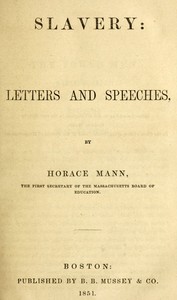
Horace Mann addresses his volume to the young men of Massachusetts, framing the fight against slavery as a matter of personal and public welfare. In the dedication, he writes that the desire for happiness is 'radicated in the soul,' and warns that moral questions will 'come closer and closer home' as readers age. This is not a detached treatise but a rhetorical call to action, grounded in the belief that youth must choose between 'hereditary' opinions and independent moral judgment.
The opening establishes a pattern: Mann alternates between principled argument and urgent political analysis. The excerpts show him dissecting the Compromise of 1850, warning that concessions to the South will lead to further expansion—'Cuba, and an indefinite career of conquest.' His voice is direct, even combative, as he insists that 'not for peace itself would I surrender liberty.'
A Dedication That Sets the Argumentative Stage
Mann’s dedication to the young men of Massachusetts is more than a courtesy; it outlines his rhetorical strategy. He posits three classes of young men: those who adopt inherited views without question, those who pursue pleasure, and those who reason independently. The excerpts do not reveal whether he names these groups again, but the framework suggests he expects readers to place themselves—and to choose the third path. The dedication’s language of 'Hopes' transforming into 'Memories' ties personal development to national duty. Mann insists that 'the institutions and laws of their country' are inseparable from private welfare, a theme that recurs throughout the letters and speeches. This opening is a deliberate bid to make abstract political issues feel immediate and personal.
The Mechanics of Moral Argument
In the later excerpt, Mann deploys a chain of cause-and-effect reasoning that is typical of his style. He traces a lineage of compromise: the Compromise of 1820 'begat the nullification of 1832,' which in turn inspired the annexation of Texas, which led to the Mexican War. Each concession, he argues, 'transfers strength from our side to the side of our opponents.' This is not emotional rhetoric but a logical warning about momentum. He uses a metaphor of a cataract—'if we cannot arrest our own course when we are just entering the rapids, how can we arrest it when we come near the verge?'—to dramatize the stakes. The argument is built on historical precedent and a belief that the North’s past failures have enabled Southern aggression.
Economic and Strategic Counterpoints
Mann addresses Northern businessmen directly, countering their fear that opposing slavery expansion will harm commerce. He argues that 'concession now' will not bring security but will instead jeopardize pecuniary interests. He predicts that if the South succeeds in the territories, they will next seek to add 'the “State of Cuba,” with its 500,000 slaves.' This is a specific, testable claim—not vague alarmism. He also notes that a slaveholding New Mexico would likely adopt free trade, undercutting the tariff protections that Northern manufacturers value. By meeting his audience on their own ground (profit and loss), Mann tries to reframe the moral question as a practical one. The excerpts show him using the tariff of 1842 as a cautionary example of Northern apathy leading to policy defeat.
Two Hopes and a Warning
Near the end of the excerpt, Mann lists two remaining hopes: that the House will reject the compromise bill, and that if it passes, New Mexico will free itself. The phrasing—'Should the north fail, I have still one hope more'—reveals his declining confidence. He calls the proposed compromise an 'adulterous union' and urges constituents to make their sentiments known 'by petitions, by private letters, or by public resolutions.' This is a direct appeal to grassroots action. The final sentence of the excerpt—'I have now, my fellow-citizens, given you my “View”'—suggests that the speech or letter is structured as a formal presentation of his position. The tone is that of a man who believes he has laid out the facts and now awaits the reader’s judgment.
Mann’s arguments are tightly woven, with each speech or letter building on historical precedent and logical inference. Readers will benefit from tracking his use of cause-and-effect chains and his habit of addressing specific audiences—young men, businessmen, constituents—within the same text. The excerpts show a writer who expects his readers to act, not merely to agree. Pay attention to how he frames compromise as a cumulative error, and note the recurring metaphor of navigation (rapids, cataract) that underscores his sense of urgency.
I have shelved Horace Mann’s Letters and Speeches for decades, its careful legal fury whispering of a nation wrestling with itself. Beside it, though, rests a quieter neighbor: the Wit and Wisdom of Lord Tredegar — Reading Companion. Odd pair, yet both speak of conviction—one through thunder, the other through a raised eyebrow. They share a shelf of steady, old-fashioned honesty.