About 857 minutes
Slavery: letters and speeches — Inside the Classic
Fantasy Juvenile Worlds
197,074 recorded words. 89 minutes difference from this book's estimate.
View Gutenberg source #70681
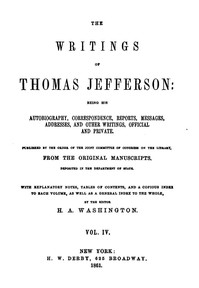
The catalog record for The Writings of Thomas Jefferson, Vol. 4 (of 9) Being His Autobiography, Correspondence, Reports, Messages, Addresses, and Other Writings, Official and Private — A Closer Reading provides practical reading context through 217,576 words, 15 hr 46 min estimated reading time, and 20 detected text sections.
The text analysis averages about 22.8 words per sentence, while the detected sections provide another way to judge how the source is divided.
Project Gutenberg metadata also associates the work with “United States -- Politics and government -- 1775-1783,” connecting these edition facts with the source record’s subject description.
Explore this collection
These alternatives are selected using recorded categories and estimated reading time.
About 857 minutes
Fantasy Juvenile Worlds
197,074 recorded words. 89 minutes difference from this book's estimate.
View Gutenberg source #70681About 747 minutes
Fantasy Juvenile Worlds
171,755 recorded words. 199 minutes difference from this book's estimate.
View Gutenberg source #34117About 701 minutes
Fantasy Juvenile Worlds
161,011 recorded words. 245 minutes difference from this book's estimate.
View Gutenberg source #18823Search stored excerpts and compare books → Choose by your preferences →
Choices use stored catalog measurements. Estimates vary with reading speed. A shared category is a catalog label, not a claim that two books have the same argument or literary quality.
Search reads excerpt text stored with this catalog and links to its associated Gutenberg record. The connection is stored in the site database; this tool does not recheck that every excerpt is word-for-word identical to that external record. Excerpt search does not cover every chapter and does not verify historical publication dates.
Catalog snapshot checked: 2026-09-25. Coverage: 94 public books, 94 available source excerpts.
Read the complete public-domain text at its original source.
Read on Project GutenbergThis fourth volume of Thomas Jefferson's collected writings covers the period from his return to the United States in 1790 until his death in 1826, encompassing letters, reports, messages, and addresses. The catalog subjects—United States politics and government from 1775 to 1865—accurately frame the content, but the excerpts reveal a more specific focus: Jefferson's sustained engagement with constitutional theory and the continuity of law. In a letter to an unidentified correspondent, Jefferson argues that the nation, not its legislative organs, is sovereign, and that laws enacted before a change of government remain binding because the nation's will persists. This doctrine, he notes, was sanctioned by the federal executive in the context of the treaty with France.
Jefferson's letter develops a core constitutional principle: the whole body of the nation is the sovereign legislative, judiciary, and executive power. He writes that the nation creates organs to declare its will, but those organs can be changed without annulling prior laws. The law is law because it is the will of the nation, not because of the particular institution that announced it. Jefferson draws an analogy to an attorney: acts done by one attorney do not lose their obligation when the principal changes attorneys. This reasoning, he claims, was used to justify the continued obligation of the treaty with France after the change in the French government, a position developed in a letter to Gouverneur Morris with the approval of President Washington and his cabinet.
Jefferson applies his principle to Virginia's legal history. Before the Revolution, Virginia had established a system of common law, statute law, and chancery. When the Declaration of Independence abolished the former organs of government, the acts of will already formally declared remained untouched because the nation was not dissolved. The common law, which was not in force when the first settlers arrived but was later adopted by the nation's organs, continued to be law after the Revolution because the nation persisted and merely changed its organs for future declarations. Jefferson contrasts this with the United States, which associated as a nation for special purposes only and did not adopt a whole system of laws ready-made.
The volume, edited by H. A. Washington and published in 1861, includes a transcriber's note indicating that inconsistent hyphenation and spelling have been preserved, and that obvious typographical errors have been corrected. Passages in French, Latin, and Italian are left unchanged. The transcriber also flagged possible inconsistencies, such as variant spellings of names (e.g., Ciracchi/Carrachi, Kosciugha/Kosciusko) and a suspected missing line on page 396. These editorial interventions remind readers that the text is a historical document, not a modern critical edition, and that some ambiguities remain unresolved.
Readers approaching this volume should be prepared for dense legal and political reasoning, often embedded in personal correspondence. Jefferson's arguments are not always systematic; they emerge in response to specific queries or events. The excerpts here offer a concentrated example of his thinking on sovereignty and legal continuity, but the volume's 946 estimated reading minutes suggest a wide range of topics. Those interested in Jefferson's constitutional thought will find this letter a key text, but it is best read alongside the other documents in the collection to gauge how consistently he applied these principles.
Reading Jefferson’s insistence that a nation’s will outlives its governments, I felt the quiet stubbornness of a voice trying to hold things together. It reminded me of Twain’s gentle, rambling way of finding truth in tangled memories. Both men wrestled with permanence, one through law, the other through laughter. Mark Twain's Speeches — Story, Setting & Ideas carries that same sense of a careful mind circling a simpler time.
Answer a few questions and save a private reflection on this device.









